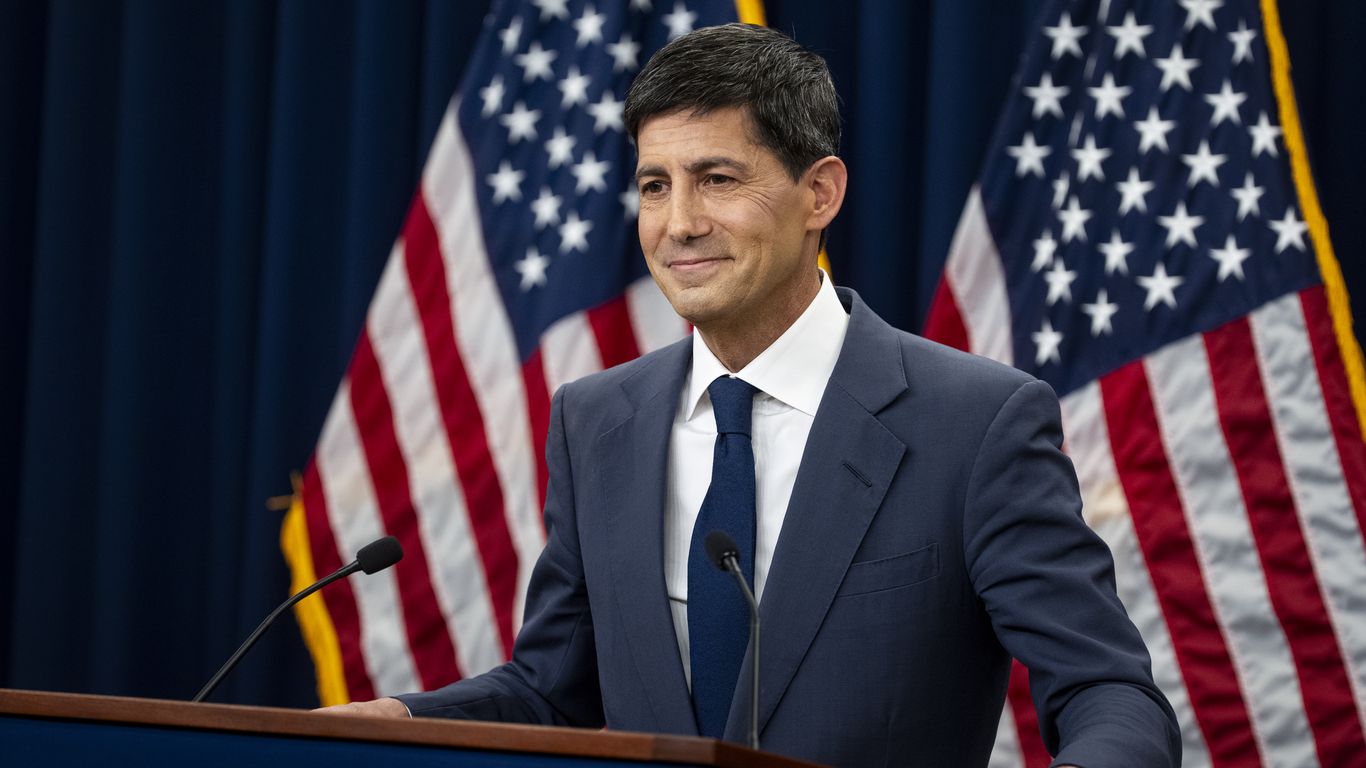
Federal Reserve chairman Kevin Warsh has created five task forces to rethink the central bank's policymaking process. They are likely to bring outside-the-box ideas combined with intellectual chops to an often insular institution.
The big picture: The task forces consist of economists and business leaders who bring serious credibility to the table but also are not part of the "Fed Borg" — that is, not among the usual lineup of people who have recently worked at the central bank.
- It is particularly telling that the task forces are lean, with three members assigned to each (with support from Fed staff).
- As anyone familiar with organizational dynamics knows, a three-person committee is more likely to arrive at crisp, potentially contrarian ideas than a larger and more unwieldy panel would.
Catch up quick: The task force leaders include a leading venture capitalist (Marc Andreessen), a former Walmart CEO (Doug McMillon) and former central bank heads (Mervyn King, Raghuram Rajan, Arminio Fraga).
- Top-flight economists include Harvard's Raj Chetty and Greg Mankiw and Nobel laureate Thomas Sargent.
- The full lineup — and their assignments — is here.
State of play: The panels are tasked with coming up with recommendations for the policy-setting Federal Open Market Committee by year-end, on topics including Fed communications, economic data collection, AI and productivity.
Advertisement
- That's a lightning-fast pace by the standards of Fed policy frameworks.
Between the lines: Even of those task force members who have worked at the Fed, none have done so recently. (Peter R. Fisher ran the New York Fed's markets desk a quarter-century ago, Karen Dynan left the staff in 2009, and Jeremy Stein's time as a governor ended in 2014.)
- While the panels include plenty of people who have expressed skepticism of elements of modern central bank orthodoxy, they do not do so from a systematically hawkish or dovish frame.
- They also don't come at things from a politically partisan lens, even those who have served in a presidential administration (as Mankiw did for President George W. Bush and Dynan, for President Obama).
Zoom in: We're particularly intrigued by the panel on economic data collection.
- Chetty is perhaps the world's leading expert in using administrative data — actual records of individuals' actions, as opposed to survey results — to glean economic insights.
- He is deeply versed in the thorny analytical, technical and legal challenges in deriving useful information from vast troves of privacy-sensitive data.
- While McMillon is at first glance an unconventional choice, his inclusion aligns with an observation we've often made over the years: Why does it take the Census Bureau weeks to produce an estimate of retail sales, while the Walmart CEO gets fresh data every day?
The intrigue: The task force on AI, labor markets and productivity is sure to generate interesting discussions, but could be the hardest to predict how its insights may map onto monetary policy.
- Andreessen is a techno-optimist who is bullish on AI's potential to create jobs; Stanford economist Charles I. Jones, currently on leave at the AI firm Anthropic, sees a productivity boom underway; and Microsoft executive Asha Sharma is in the trenches of wrestling with AI-driven change.
Reality check: The task forces have no power on their own, but rather their influence will rest on their ability to persuade the FOMC that their critiques hold up to criticism.
Advertisement
The bottom line: "The experts chosen skew some to those who differ in at least some respects with current Fed practice," Evercore ISI's Krishna Guha and Gang Lyu wrote in a note.
- "But in each case there is a serious and broadly balanced group that will be taken seriously by the market, Fed staff and the members of the FOMC who in most cases will ultimately have to agree to material changes."