A new bill could change how the US builds energy infrastructure
Artificial Intelligence · November 5, 2026
An AI pilot can run successfully on a small dataset, a handful of users, and considerable attention from an engineering team.
Enterprise deployment is a different proposition. Once an AI system begins serving thousands of employees, customers, or automated workflows, it must interact with databases, applications, documents, identity systems, APIs, and infrastructure that were often designed long before generative and agentic AI became part of the technology roadmap.
That is where modernization becomes important. The question is no longer whether an organization can connect a model to its data.
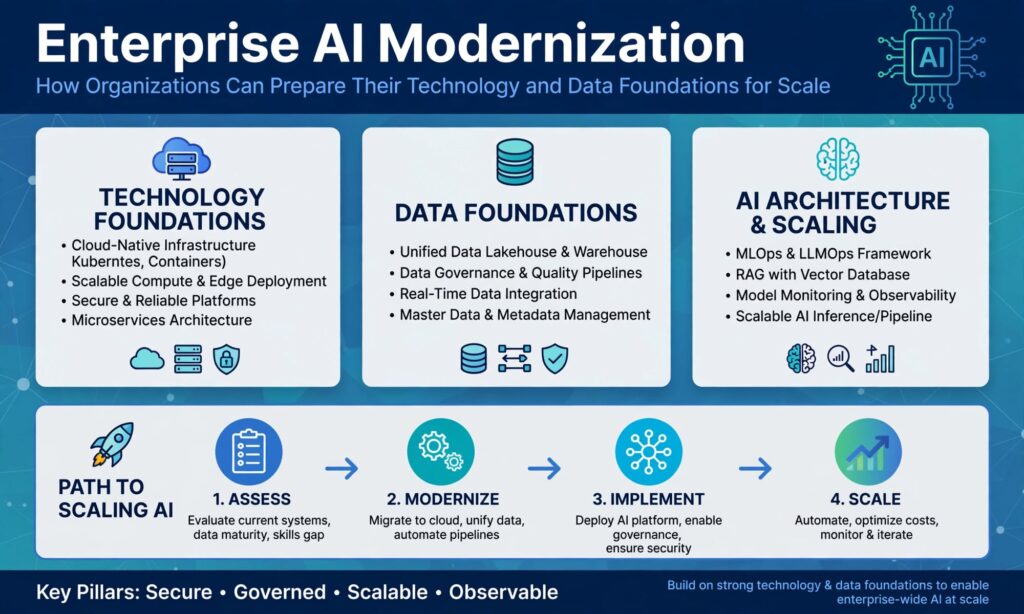
It is whether its technology environment can support repeated data retrieval, model changes, real-time processing, security controls, monitoring, and rising compute requirements without creating a separate technology stack for every AI application.
For technology leaders, the task is therefore broader than upgrading infrastructure.
It involves making the data, applications, integration layer, computing environment, and governance model work together. AI exposes weaknesses that conventional applications could tolerate. Many enterprise systems were built around relatively predictable transactions.
An ERP system records an order.
A CRM system stores a customer interaction.
A warehouse system tracks inventory.