Chrome may be the default browser on Android, but more people are trying this instead
Technology · July 15, 2026

The touchscreen MacBook Pro has been the subject of speculation ever since Bloomberg’s Mark Gurman first reported that Apple was exploring the idea in 2023. At the time, the prospect seemed unlikely given Apple’s long-standing opposition to touchscreen laptops. Today, however, the rumours are becoming increasingly difficult to dismiss.
Recent reports suggest Apple has key technical and design hurdles, paving the way for the first touchscreen MacBook Pro. Industry observers are now combing through the recently previewed macOS 27 Golden Gate for further clues that touch support is on the way. If the reports are accurate, the touchscreen will arrive as part of a major overhaul of Apple’s flagship laptop. Rumoured upgrades include OLED display technology, a redesigned chassis, and next-generation Apple Silicon, making the update one of the most significant in the MacBook Pro’s history.
The timing would be fitting. In 2026, the MacBook Pro celebrates its 20th anniversary, and Apple could mark the occasion with a feature many believed would never make its way to a Mac. Some analysts believe the move would help further distinguish the MacBook Pro from the MacBook Air and the rumoured budget-friendly MacBook Neo.
There are still questions surrounding pricing, however. Ongoing supply-chain challenges and the higher cost of OLED panels could push prices up compared with current models.
Apple is widely expected to launch a redesigned MacBook Pro with a touchscreen OLED display in late 2026 or early 2027. While the company has yet to officially confirm the device, reports from industry analysts and references discovered in Apple’s software suggest that development is well underway.
Most rumours point to two possible launch windows:
Evidence supporting a 2026 release continues to emerge. According to reports from the South Korean Naver blog, Samsung has begun production on its new 8.6-generation OLED manufacturing line, which is expected to supply panels for the next-generation MacBook Pro. The start of display production suggests Apple could be on track to launch the laptop before the end of 2026.
Further backing this timeline, Mark Gurman reported in February that the M6 MacBook Pro is expected to arrive in the “back half” of 2026.
However, a delay remains possible. In April, Gurman reported that supply-chain issues were affecting development of the redesigned MacBook Pro, potentially pushing its release into 2027.
For now, the most likely scenario is a launch in late 2026, with early 2027 serving as a fallback if production challenges persist.
Both Bloomberg’s Mark Gurman and analyst Ming-Chi Kuo have reported that Apple is developing MacBook Pro models with OLED touchscreen displays as part of a major redesign. Most reports indicate that the feature will debut on the high-end 14-inch and 16-inch MacBook Pro models powered by M6 Pro and M6 Max chips, making them the first Macs to support direct touch input.
The touchscreen is expected to be a key feature of the M6-generation MacBook Pro, helping Apple further distinguish its professional laptops from the more affordable MacBook Air and MacBook Neo.
For now, the technology appears set to remain exclusive to the MacBook Pro lineup. Neither the next-generation MacBook Air nor the entry-level MacBook Neo is expected to gain touchscreen support in the near term. However, Kuo believes Apple could eventually expand the technology to other MacBook models if the touchscreen MacBook Pro proves successful.
The MacBook Air is considered the most likely candidate for a future touchscreen upgrade, although current forecasts suggest this would not happen until at least 2028 or 2029. Some reports indicate that the Air could adopt OLED display technology before then, albeit without touch functionality.
The touchscreen MacBook Pro is expected to arrive as part of the biggest redesign to Apple’s professional laptop lineup in years. According to multiple reports, Apple is working on a thinner, lighter MacBook Pro made possible by more efficient Apple silicon and OLED display technology.
Bloomberg’s Mark Gurman first reported in 2024 that Apple was planning to slim down the MacBook Pro. The current 14-inch MacBook Pro measures 0.61 inches (1.55cm) thick when closed, and while the redesigned model is expected to be noticeably thinner, it will likely remain slightly thicker than the MacBook Air to accommodate its more powerful hardware.
One of the most significant visual changes could be the removal of the display notch. Reports from display analysts and Bloomberg suggest Apple may replace the current notch with a hole-punch camera cutout, allowing for more usable screen space around the sensor. In early 2026, Gurman went a step further, claiming the new MacBook Pro could adopt an iPhone-like Dynamic Island interface built around the camera cutout.
The touchscreen MacBook Pro is also expected to retain its traditional laptop design, complete with a full keyboard and large trackpad, rather than becoming a hybrid tablet device.
Other rumoured design changes include:
These changes would help distinguish the MacBook Pro from the MacBook Air and the entry-level MacBook Neo while giving Apple’s flagship laptop its most substantial design update in years.
This redesigned model is anticipated to feature a major display overhaul, transitioning to an OLED panel that will likely offer a slimmer form factor similar to the iPad Pro
The display is expected to be the headline upgrade of Apple’s redesigned MacBook Pro. Multiple reports suggest Apple will replace the current Liquid Retina XDR (mini-LED) panel with a touchscreen OLED display, bringing MacBook Pro technology closer to the Ultra Retina XDR display used in the latest iPad Pro.
According to analyst Ming-Chi Kuo, Apple is planning to introduce OLED touch panels in the MacBook Pro in late 2026 or early 2027. The new display is expected to be thinner, more power-efficient, and capable of delivering deeper blacks, higher contrast, richer colours, and improved HDR performance than today’s mini-LED screens.
Reports indicate that both the 14-inch and 16-inch models will use advanced tandem OLED technology, which combines two OLED layers to achieve higher brightness levels while maintaining excellent energy efficiency. Apple first introduced this technology with the M4 iPad Pro and is expected to bring a similar implementation to the MacBook Pro.
The touchscreen functionality will reportedly rely on on-cell touch technology, which integrates touch sensors directly into the display rather than adding a separate layer. This approach helps keep the panel thin while supporting multi-touch input.
If the rumours prove accurate, the move to a tandem OLED touchscreen would represent the biggest display upgrade in the MacBook Pro’s history and one of the most significant changes to the lineup in years.
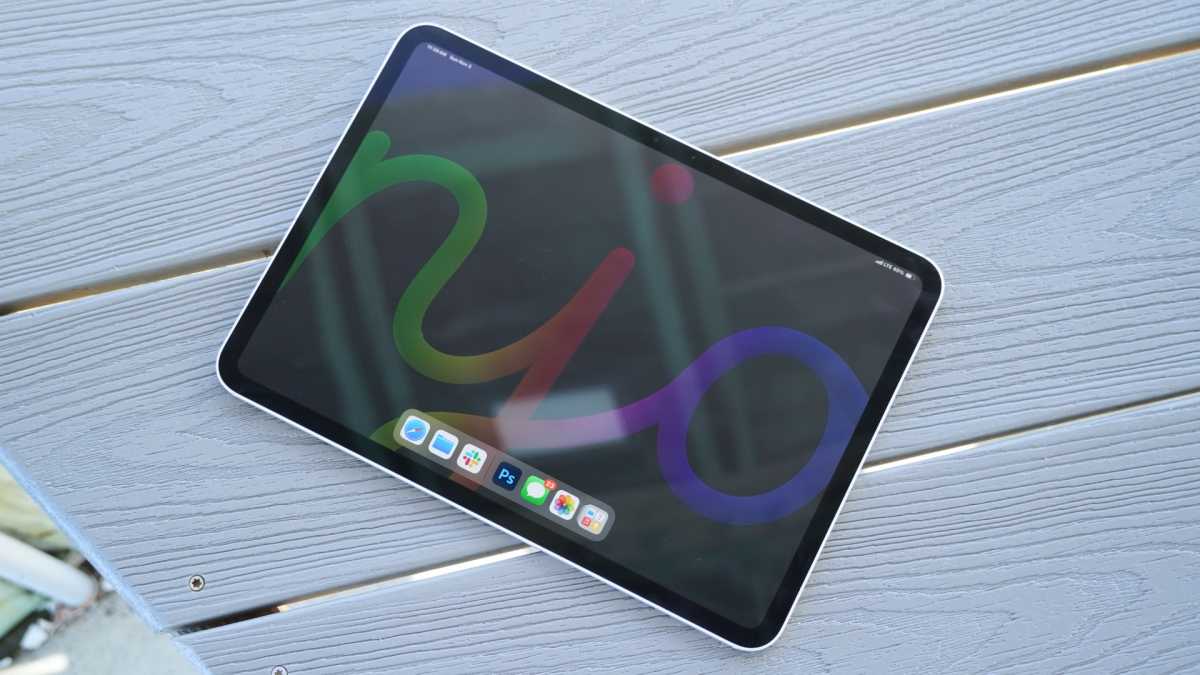
The iPad Pro has a Tadem OLED display, the type of display that could make its way into the 2026 MacBook Pro.
Brady Snyder / Foundry
Apple is not expected to turn macOS into iPadOS, but reports suggest macOS 27 could include subtle design changes to make the Mac easier to use with touch input.
Rather than replacing the traditional desktop experience, Apple is reportedly working on a touch-tuned interface that adapts depending on how the device is being used. When touch input is detected, interface elements such as menus, buttons, and controls may automatically enlarge to make them easier to tap. When using a mouse or trackpad, macOS would revert to its familiar point-and-click layout.
The touchscreen itself is expected to support standard gestures such as tapping, scrolling, and zooming, while still allowing users to switch between touch, trackpad, and mouse input.
Apple is unlikely to announce touchscreen Mac support outright at WWDC, but the preview of macOS 27 could offer clues about how the company plans to make macOS more touch-friendly while keeping the MacBook and iPad lines distinct.
There has also been speculation that Apple could update the trackpad with a new sensor layer to support Apple Pencil features such as hover or writing, possibly alongside a wider trackpad aimed at creative workflows.
The touchscreen MacBook Pro is expected to debut alongside Apple’s next-generation M6 chip family. Early reports suggest the M6 could be manufactured using an advanced 2nm process, delivering significant improvements in both performance and power efficiency compared with current Apple Silicon chips.
If Apple launches the touchscreen MacBook Pro with M6 Pro and M6 Max processors, those chips could feature a redesigned architecture. Reports indicate Apple is moving towards separating the CPU and GPU into distinct blocks, a change first rumoured for the M5 Pro and M5 Max. This approach could provide greater flexibility in configuring processor and graphics performance across different models.
Leaked Apple files discovered by MacRumors in late 2025 reportly contained references to M6 MacBook Pro models, further supporting claims that development is already underway.
There is also speculation that Apple could introduce cellular connectivity to future MacBook Pro models, potentially allowing users to connect to 5G networks without relying on Wi-Fi or a smartphone hotspot. However, this remains one of the less substantiated rumours surrounding the redesign.
While few details have emerged about the exact specifications, the combination of a new chip architecture, improved efficiency, and potential connectivity upgrades could make the touchscreen MacBook Pro one of the biggest performance leaps in the lineup’s history.

Apple
Beyond the touchscreen display and redesigned chassis, one of the most intriguing rumours surrounding the next-generation MacBook Pro is built-in cellular connectivity.
Apple has spent the past several years developing its own modem technology, beginning with the C-series modem family. Reports suggest the company has explored bringing 5G connectivity to the MacBook lineup, allowing users to connect directly to mobile networks without relying on Wi-Fi or a smartphone hotspot.
Further evidence emerged in 2025 when Macworld contributor Filipe Esposito reported that Apple had tested an M5 MacBook Pro equipped with a 5G modem. While that feature did not make it into the final product, the report suggests Apple is actively evaluating cellular-enabled MacBooks.
The redesigned MacBook Pro could also benefit from Apple’s growing portfolio of wireless chips. The company’s N-series networking processors, which handle Wi-Fi, Bluetooth, and Thread connectivity, may eventually replace third-party components throughout the Mac lineup. An updated version of the chip could debut alongside the touchscreen MacBook Pro, improving power efficiency and tighter integration with Apple’s ecosystem.
While neither feature has been confirmed, Apple’s ongoing investment in modem and wireless technologies makes enhanced connectivity one of the more plausible additions to the redesigned MacBook Pro.
Apple will likely offer similar configurations to the current MacBook Pro models, but it’s unclear how much of a premium a touchscreen OLED display will command. Apple upped the price of the iPad Pro by $200 when it got a tandem OLED, so it’s likely the touchscreen MacBook Pro will have a higher starting price.
Here are the prices for the current standard configurations of the M4 MacBook Pro These prices are provided here as reference points.
14-inch MacBook Pro
16-inch MacBook Pro