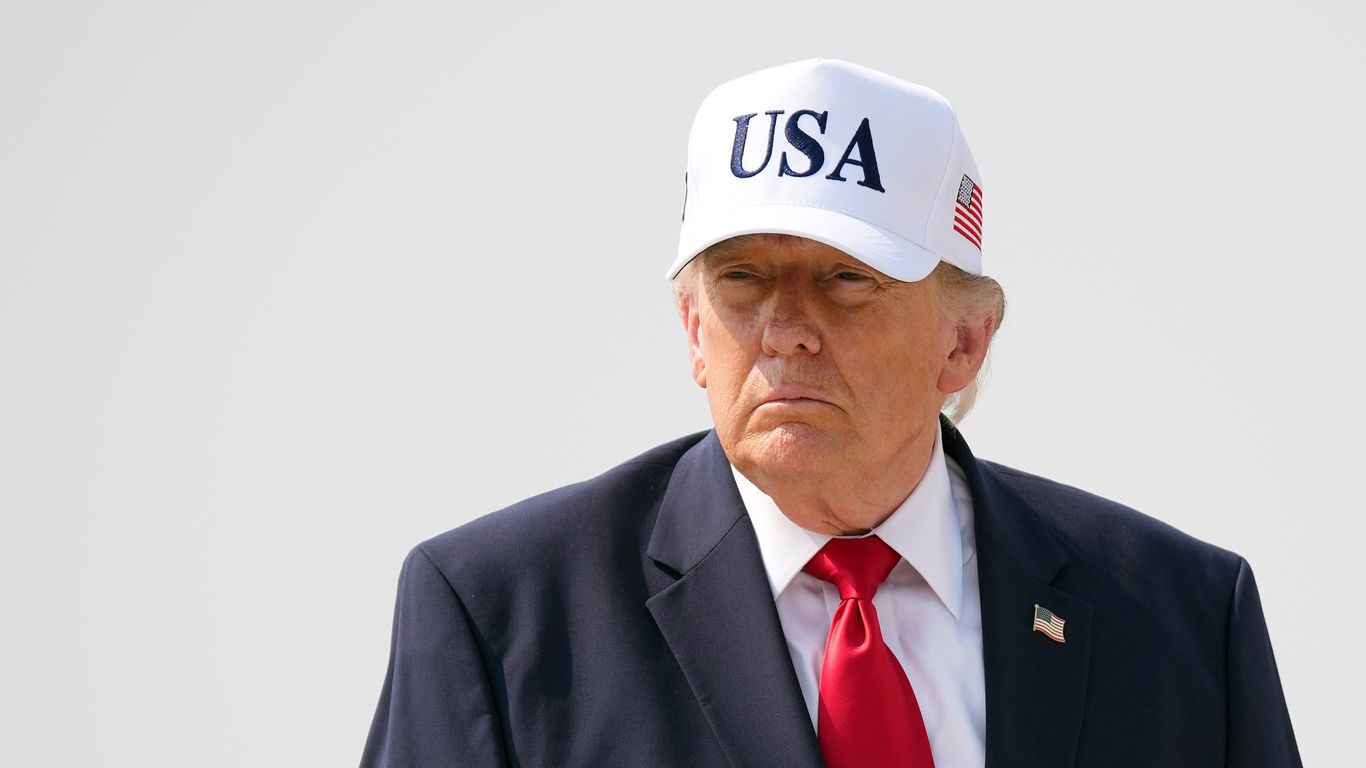
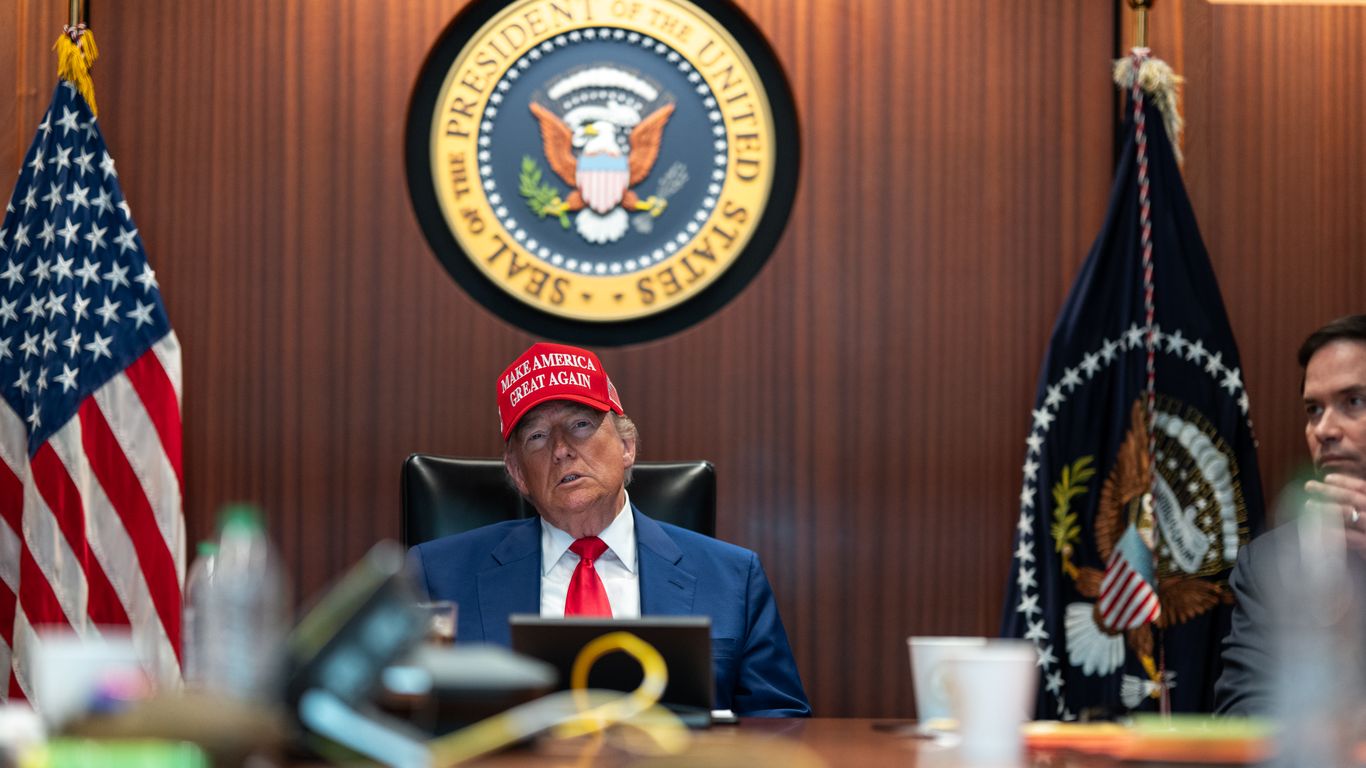
President Trump announced on Monday that the U.S. is reinstating the naval blockade on Iran and will prevent any ships from leaving or entering Iranian ports. The blockade will go into effect on July 14 at 4pm ET.
- Trump also claimed the U.S. would be "reimbursed" at a rate of 20% for securing safe passage for cargo ships, though the details and seriousness of the initiative were not immediately clear.
Why it matters: The blockade — a response to renewed clashes between the U.S. and Iran in recent days — threatens to dramatically escalate tensions in the strait and change the economics of shipping energy and materials in the Middle East.
Driving the news: After a day of negotiations with regional mediators on Saturday, the IRGC attacked another ship and declared the strait "closed until further notice" — triggering two round of U.S. strikes on Iran on Saturday and Sunday.
- A U.S. defense official said the U.S. military has plans for several days of additional strikes in the Hormuz area and on Iran's southern coastline aimed at degrading the IRGC's ability attack ships.
- The U.S. defense official claimed the southern route in the strait of Hormuz is still open, with at least 20 ships transiting through in coordination with the U.S. and several others without coordination.
What he's saying: "The Hormuz Strait is OPEN, and will remain OPEN, with or without Iran. We are reinstating the THE IRANIAN BLOCKADE, so named because it is only stopping Iran's ships or customers from entering or leaving. All other countries will have fair and open use of the Strait," Trump wrote on his Truth Social account.
Advertisement
- He added that the U.S. "will be, from this point forward, known as 'THE GUARDIAN OF THE HORMUZ STRAIT'" and will ask to be "reimbursed, at the rate of 20% on all cargo shipped" in exchange for providing security.
- "The process and formation will begin immediately. Thank you for your attention to this matter!" Trump wrote.
State of play: The U.S. Navy announced on Tuesday that the blockade will come into effect on July 14 at 4pm ET.
- "U.S. Central Command will begin enforcement of a naval blockade of all Iranian ports and Iranian coastal areas. All neutral vessels are hereby warned and have the period until enforcement begins to depart the blockaded area," the Navy statement said.
- The Navy said the blockade "encompasses the entirety of the Iranian coastline to include but not limited to Iranian ports and oil terminals," and applies to all vessel traffic, regardless of flag.
- "Any vessel suspected of entering or departing the blockaded area without authorization is subject to interception, diversion, and capture. Non-compliant vessels may be legally compelled with force."
Between the lines: Transit of ships through the Strait of Hormuz to or from non-Iranian destinations will not be impeded, according to the announcement.
- Humanitarian shipments like food and medical supplies will be permitted to reach Iranian ports, subject to inspection.
The intrigue: A senior Gulf source told Axios the U.S. hasn't discussed the issue of possible tolls for securing the Strait of Hormuz with its allies in the region.
The other side: Iranian Foreign Minister Abbas Araghchi used Trump's statement to justify Iran's demand for collecting service fees from ships that pass through the strait.
Advertisement
- "POTUS is absolutely right. Whoever provides secure and safe passage of commercial vessels through the Strait of Hormuz should be compensated for this service. Iran has always been the GUARDIAN of the Strait and will remain so FOREVER. 20% is of course too much. We will be fair," he wrote on X.
- Lebanon's Al-Mayadeen TV network, which is affiliated with the pro-Iranian "Axis of Resistance," quoted an Iranian security official who claimed Iran still controls the strait and will escalate its response if the U.S. continues its "provocative behavior."
- "The security and administration of the Strait of Hormuz are determined by Iran's will — not by Trump's tweets and not by the presence of warships," the Iranian official told Al-Mayadeen.
This is a breaking news story. Check back for updates.