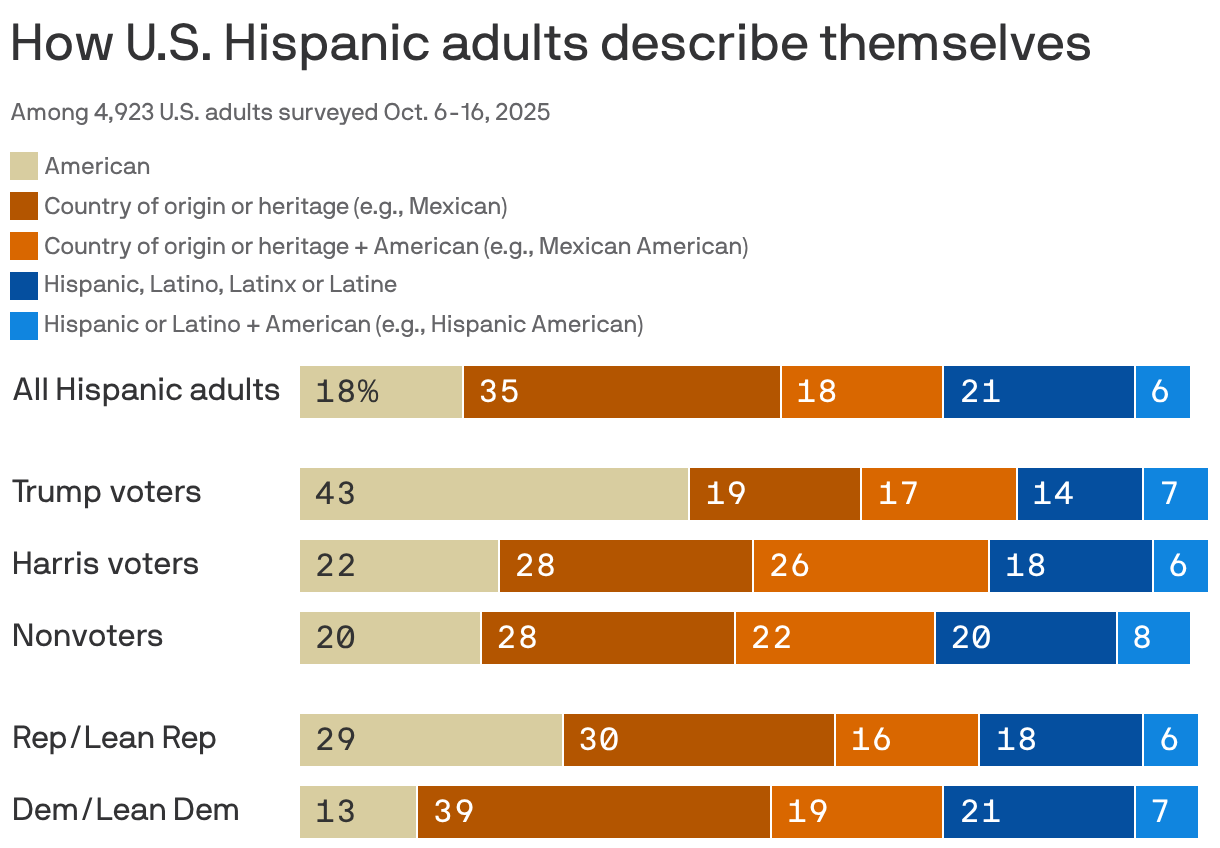
Data: Pew Research Center; Chart: Danielle Alberti/Axios
Latino voters aren't just splitting over President Trump. They're divided over how being Latino shapes their identity in America, according to a new Pew Research Center report.
Why it matters: This is a deeper fracture than a typical partisan divide — Latino voters are splintering over whether their ethnicity feels like a barrier, an asset or is politically irrelevant.
- That's complicating how both political parties try to reach one of the nation's most important swing constituencies ahead of the November midterms.
By the numbers: A majority of Latinos who backed President Trump in 2024 — 57% — say what happens to Latinos in the U.S. affects their own lives "not too much" or "not at all," according to the study released Thursday.
- Meanwhile, 75% of Latinos who voted for Kamala Harris say what happens to Latinos affects their lives a great deal or a fair amount.
- Six in 10 Latino Trump voters say they never or not too often feel a responsibility to look out for other Latinos in the U.S.; only 20% of Harris voters say the same.
State of play: In the 2024 presidential election, nearly half of Hispanic voters backed Trump — the best performance by a GOP presidential candidate in modern times, according to an Axios review of past elections dating to 1960.
Advertisement
- The survey lands as Democrats are trying to win back Latinos from the GOP, particularly by trying to rebuild trust on Democrats' approach to the economy and working-class issues.
The intrigue: Pew's findings suggest the challenge for Democrats — and the opportunity for Republicans — isn't just economic messaging.
- Latino voters are increasingly divided over whether being Latino itself is central to their political and personal lives.
- The study's authors write that Hispanic identity differs sharply by political leaning and immigrant generation — and that the gaps between 2024 Harris and Trump voters "are often even more pronounced."
Zoom in: The divergence extends to the identity labels Latinos use in their daily lives.
- Hispanic Trump voters are nearly twice as likely as Harris voters — 43% vs. 22% — to most often describe themselves simply as "American."
- Harris voters use a wider mix of labels, with a majority (54%) using country of origin either alone or combined with American, such as "Mexican American."
Zoom out: The community is broadly divided on its lived experiences in America.
- About a third of Hispanic adults say they've experienced discrimination or unfair treatment in the past year because of their ethnic background by someone who is not Hispanic.
- But a majority (54%) say they haven't experienced any of the four Hispanic-related discrimination incidents asked about in the survey.
Yes, but: Despite these deep ideological and experiential divides, some shared views remain.
Advertisement
- Across the board, almost no one is adopting certain progressive terminology: A mere 1% of Hispanics prefer the term "Latinx," and just 1% prefer "Latine."
- Pew also reports that 54% prefer Hispanic, 30% prefer Latino and 14% have no preference.
Between the lines: The old assumption that "Latino" works as a single political identity is breaking down.
- For Harris voters, identity is more likely to be tied to a shared fate, discrimination and a sense of collective responsibility.
- For Trump voters, identity is more likely to be filtered through American identity and a feeling that what happens to other Latinos doesn't necessarily affect them.
The bottom line: There's no single Latino vote, and Pew's report suggests there may be no single Latino identity driving it.
Methodology: Pew's report is based on a survey of 8,046 U.S. adults, including 4,923 Latinos ages 18 and older. Of the Latino respondents, 1,125 were members of the Center's American Trends Panel and 3,798 were members of SSRS's Opinion Panel.
- The primary survey is Pew's National Survey of Latinos, conducted Oct. 6-16, 2025, in English and Spanish, primarily online with some interviews conducted by telephone.
- The margin of sampling error is ±2.6 percentage points for Latino adults at the 95% confidence level. The margin of error is ±5.7 points for validated Trump voters and ±4.2 points for validated Harris voters.