Forex Trade Management – What to do After You Enter a Trade
Forex · July 15, 2026
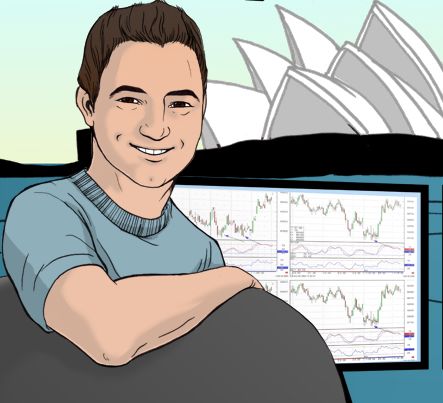
Nial Fuller is a professional trader with more than a decade of experience trading a wide range of financial markets. He is founder and director of Learn To Trade The Market.
The following interview with Nial Fuller was based on a series of questions that we received from one of our members. We used the opportunity to provide you with some in-depth insight into how Nial trades, what his daily trading routine is like and a lot more. Hopefully, you will learn something from Nial’s responses…
How did you get into the trading game?
When I was 16, my economics teacher was encouraging us to learn about the stock market and he held a school share market competition, from there I started to get more and more interested in stock trading and by the age of 18 I had developed a full-blown interest in financial market trading. In fact, on my 18th birthday I placed my first live trade, at that time I was trading anything from shares to options and then later got into futures and currency trading. Back in those early days, I was literally reading any book or website I could find on trading, I was trying to learn everything I could. I had been bitten very hard by the “trading bug” by the age of 18.
Advertisement
Can you provide us with an overview that helps us understand your focus and strategy to making money in the markets?
If you look around my blog, I’m obviously an advocate of price action trading, what that really means in simple terms is that you’re looking at a ‘naked’ price chart with nothing on it but the price bars, primarily a daily chart. Primarily, I am just looking at price data in its raw form and I look for price action signals to help me pin point a trade entry, and some things that help with that; obviously you want to know the directional bias, which is the trend, you want to know where the key major levels are in the market, whether it’s a recent high or low or major longer-term levels. Then, I combine price action signals, which we will probably discuss more later. So, the three things I look for are the trend, levels and price action signals, when we have those three things in alignment, I like to place a trade.
What types of markets dominate your trading now?
I’ll look at anything that is liquid and moving a lot, you want to trade markets that you will be able to get in and out of at any time. I often hear people trading markets that gap a lot, like stocks, I think I’ve moved past taking on those kinds of risks and I like to trade large size in markets that have deep liquidity such as Forex and stock indices, instead of the actual stocks and shares themselves, as well as some commodities like gold and silver. These are markets that have huge amounts of volume every day and you have no problem getting in and out of them when you want.
Advertisement
What methods do you use to analyze the market?
Price action is my only focus.
What would you say are your favorite kinds of setups?
I’ve got three primary setups; the pin bar, the inside bar and the fakey setup, they’re all solely price action based. Usually, I like to trade them in the direction of the primary daily chart trend, you can trade them against the trend, but for anyone reading this who is a complete beginner, I strongly suggest you that you study these methods and trade them only with the obvious directional bias that’s currently underway.
Advertisement
How do you find and select potential trades?
I have a trading plan which contains my price action setups, definitely aligning three things: the current trend of the market, key levels and a price action signal, and in short that’s “T.L.S”…Trend Level Signal. I at least want to have two of those things in alignment, or confluence, and that makes for a high-probability trade for me, and obviously there’s going to be some other factors involved which may vary depending on your circumstances, but for me they might be things such as the amount risked, your profit target, stop loss, and any other factor you want to put into your trading plan. Anyone who is serious about trading will make their decisions based off their trading plan which is a predefined set of rules that help you filter good and bad signals in the market.
Take us though a previous trade that offers insight into what you do and how you do it.
Recently, I took a trade on the Aussie/dollar in the context of the strong downtrend we’ve had in this market recently. I’ve been looking for retracements back to value, or an area that I can see is an obvious area of resistance…this is trading in-line with the daily chart momentum. If you’ve got a downtrend and the market retraces back to value, I will look for a price action sell signal. In the case of the trade setup on December 3, we had a nice little reversal from resistance and I got in. To keep it in-line with current events and to keep it real, that was my most recent trade, it was a ‘tailed’ reversal bar with the trend…which wasn’t really a precise version of what I teach (wasn’t really a pin bar) but the logic of the trade was correct: Trend, Level, Signal…just keep that in your head..T.L.S.
Advertisement
What markets do you trade?
I’m really only concerned with Forex, indices and Gold…these are offered as a CFD in most parts of the world, maybe slightly different in America. The bottom line, is that I don’t trade physical futures, I just see no need to when you can trade the CFD, which has a different margin requirement.
Interviewer: What does CFD stand for those who are not familiar with the acronym?
The idea is that it’s just a contract with a broker (Contract For Difference) and you can trade everything; any market you want, but I trade Forex, stock indices and Gold mainly and I just trade them out of a Meta trader trading platform.
Advertisement
How actively do you trade?
I don’t trade very often at all, probably no more than a few times a week. I’m more of a large position size trader. If I see a trade I really like I will often back myself and go in pretty hard.
What are your average hold times for positions?
Anywhere form a couple of days to a couple of weeks, if I get onto a nice trend it might be a couple of months. Most of the time no more than a week, but I certainly like to let things run their course, I’m more of a set and forget kind of trader where I’ll place the trade and walk away from it and let the risk reward scenario come off, so it’s either a stop out or the reward / target is hit and usually that’s anywhere from 2 to 1 or 5 to 1.
Advertisement
Do you have a profit target you try to hit every week, month or year?
No, I don’t because I don’t believe that is a realistic thing to do, the market is going to produce XYZ number of trades and your risk reward is always a random outcome on every trade and you never know exactly what you’re doing to get. So, you can’t force a profit target into a monthly or weekly period, you just work with the market as things unfold, you take the good trades and the bad trades and add them up at the end of every month.
Take us though your daily routine from start to finish.
I get up [in the morning] like every other person, but the difference with me is that when I go over the charts in the morning while having breakfast, it’s around the New York close, which fortunately for me since I’m in Australia is my morning. I’ll just look for any obvious price action setups, draw my key levels on the charts, workout what’s happened overnight and see if anything has changed and if there’s something decent setting up then ill place my orders in the market pretty much right there and then, whether it’s an instant entry or a limit order which is a pending order. Then I usually come back in the late afternoon to see where we are at heading into the London open and then I might check the trades again before bed. But, honestly when you’re trading the daily charts you don’t have to look at the charts too much, I guess I’ve got more of a relaxed lifestyle trading that higher time frame, the daily charts.
Advertisement
How has your approach to the markets changed and improved throughout your career?
When I first started, I was trading shares and I had very little success, for the first few years trading options and shares, just things that a lot of newbies get into. I just had the wrong markets and the wrong time frames. You know, I change products and I’ve changed my time horizon for trading, I’ve moved away from intra-day short-term trading to daily chart trading and I’ve changed markets from shares
Short answer; I used to trade stocks, shares and options on intra-day charts, but I’ve moved onto Forex on daily charts, so different time frames and different products and I’ve slowed things way down in my head.
Has the influence of program trading had any impact on your approach?
No, I’m not a day trader, I believe everything in the world is a free market, we’re in a capitalist society and things tend to work themselves out regardless of what algorithms and computers are in the market, so I don’t really care about it too much.
Looking back was there any specific thing that you thought was a key turning point in your career?
Yes, I used to try and pick tops and bottoms a lot, a lot of people like to fight the current momentum in the market. One thing I learned is that markets go a lot further than you think they will, they always tend to keep going and they will mow you down if you stand in front of them. I think that’s one thing, you wait for periods in the market where there’s a freight train moving in one direction and you get on board, you don’t stand in front of it trying to pick the top or bottom as most people do. That’s why most people are losing money in the market; they’re betting against the market, but more money is made going with the market than any other method out there.
Among all the factors you discuss in your weekly trading articles, which were the most difficult for you to learn and why?
I write often about things that I have dealt with or struggled with personally, most of the time I’m writing about remaining patient and sitting on the sidelines. If most of my articles are based on me trying to connect with people and things that I have struggled with personally, I would say patience and low-frequency trading are things that I used to struggle with but that I have now mastered and I’m trying to instill in other people.
Why do you think your method of trading is best for you and what recommendations can you provide for aspiring trades who desire to find, figure out, and then employ a method that works for them?
I’ll answer that questions in two parts. First, I like to live my life very simply; I’m a minimalist. I don’t own a lot of ‘stuff’, I don’t do a lot of things and I really value my free time. The daily chart trading / low frequency trading definitely fits with my personality, lifestyle and the way I think; it’s very clean and simple and doesn’t take a lot of time. I certainly don’t want to sit here and watch the market all day, I have better things to do.
If day trading is not the right path for most, then what is the path you think is best for the majority of traders?
Day trading is gambling, anyone who has tried it either wakes up pretty quickly or gets addicted, and God help you if you get addicted to it. If you try day-trading you’re pretty much guaranteed to blow your first few accounts and probably the next few accounts as well, because you’re basically playing a game that is rigged. Short-term movements in markets can be manipulated very easily and have very little structure in comparison to the larger time frames. So, it’s really just gambling and I would strongly suggest people stay away from day trading.
Having said that, moving onto the daily charts, it’s still going to take some getting used to and a lot of study, but you’re slowing things down, anytime you increase your time frame you’re slowing things down. Your risk becomes less as your skill improves on the daily charts because your starting to play with the larger money, when you’re playing with larger money like on the 4hr and daily charts, that’s where the money is being committed.
What are the biggest mistakes made by novices and aspiring traders?
I think we’ve already covered these, but just to reiterate, most people want to buck or fight the trend and try to pick tops and bottoms. People trade too big of positions sizes too often, basically, over-committing in the money management side is a big problem. Also, using indicators and looking at the charts through “rose colored glasses”, they don’t seem to see what’s really there. Trying to curve fit things into indicators and ‘sophisticated methods’. Keeping it simple is something people don’t do when they start.
Advertisement
How many years do you think it takes for a trader to learn the ropes?
To learn all the basics, inside of 2 years. But, to really get to the point where you’re trading serious money and doing well, anywhere from 2 to 5 years. That might seem like a long time, but university degrees take 3 or 4 years. They say 10,000 hours to become an expert in any field, and I feel that holds true for trading.
The reason most people lost money, honestly, is because they are under-capitalized and they trade too big for their account size or they just don’t want to wait for the perfect trades.
In your price action trading course, you say that trading psychology is one of the most important trading components, why?
Essentially, without the correct trading mindset, a trader’s strategy or edge in the market means very little. A trading strategy alone won’t make you profitable in the long-run, it’s a combination of the right mentality, money management and method, sometimes this is referred to as the “Three M’s”.
How do you manage risk? What methods do you employ to minimize losses when your analysis or positioning is wrong?
I use the fixed dollar risk method because I believe two things: I don’t believe people should compound accounts, instead I believe people should take out their profits and use them, in trading that is, but this won’t apply for longer-term investing necessarily. Next, I believe in knowing what you’re going to risk, a fixed amount of money and you put that on the line in each trade and be consistent with it. At the end of the day, if you used the ‘other’ risk model, the percentage risk model, it’s really just a way of losing money slowly. If you’ve lost half your account you basically have to make 100% of your account just to get back to breakeven. So, if you’ve got any skill and experience underneath you, the dollar risk method just makes a lot more sense.
How do you determine if a trade has failed other than its performance after entry?
There are a few things to look at with trades that fail: it’s either hit your stop or there’s been an opposing signal or too much time has elapsed since entry. It’s very tricky to try and put it “into a box” here and give everyone a more specific answer, but usually trades come off within a few days, so if things aren’t going your way within a few days you might want to think about why you’re in the trade, or if you get an opposing signal that’s close by that is dominating the chart, you want to be mindful that you’ve just had something trigger in the opposite direction. But, most times I’ll just stay in a trade until the stop loss is hit, 90% of the time I am committing to the trade no matter what happens. I definitely would not get out of a trade based on a lower time frame signal, so if I entered on a daily chart I will not let an intra-day signal scare me out of the trade, again it’s the ‘set and forget’ mentality.
Do you ever average down into a losing trade?
To quote one of Wall Street’s greats, Paul Tudor Jones: “losers average losers”. That’s about all I have to say about that.
Can you explain the particulars concerning your stop loss method?
Stops should be placed in logical areas, not just arbitrarily placed because you want to risk a certain amount of pips in the market. They’ve got to be placed at logical levels, so if there’s a support level and you’ve got a price action signal, don’t just place your stop below the signal, if there’s a nearby level there you want to try and get your stop loss below or above that level as well. It’s not always going to be the case that you can get the ‘perfect’ stop loss placement, but just think about them as something to get you out if things really going wrong in the context of the chart itself, it’s not just that one little price bar that’s got you into the trade as the entry signal, look for the overall dynamics and the context the price bar is forming within. That’s how I put my stops in, I don’t just arbitrarily place them at highs and lows of signals or because there’s a certain amount of pips there.
To give others some idea of overall performance, what is your historic % win / % loss ratio and your $ win / $ loss ratio?
Generally, my win rate is below 50%. Average win rate will typically be between 30 and 50%, it fluctuates. But you know, it’s usually under 50% and with a strike rate like that you’re going to need a few ‘home run’ trades in there, but my average winner will be anywhere from 2 to 1 or 3 to 1, but you need a few in there that are really going to put you in front.
Look, the percentage of winning will usually be below 50%, statistically it fluctuates between 30 to 50%, that said, average reward on risk is just above 2 to 1, but that doesn’t mean on every trade we are aiming for 2 to 1 as we will have to get some bigger winners in there somewhere, it just means that the average is 2 to 1.
Advertisement
You have written that managing emotions (fear, greed, and false-hope) is the primary challenge of a trader. What methods do you employ to address this challenge?
Essentially, a trader can only transition into profit once he or she is at peace with himself or herself mentally, and you can’t obtain that without consistent practice and discipline on a daily basis. I’ve written on article on daily trading affirmations, you definitely want to reconfirm to yourself a lot of the traits that are required to be a trader. I suggest anyone who is reading to go and read that article on a daily basis, print out the parts that are important to you and read them on a daily basis. Self-belief should not have to come after you’ve already had success, self-belief is almost a leap of faith and it’s how almost all entrepreneurs, traders and business people become successful; by acting “as if” they’re already where they want to be. Believing 100% that you’re already ‘there’ and successful can significantly help with controlling your emotions and developing the correct trading mindset.
While you have traded for over a decade, you are relatively new to the world of sharing your thoughts, opinions and analysis with the public. What have you learned?
It’s a definitely a gratifying experience but also a challenge. It’s both rewarding and challenging even after 6 years. I really enjoy what I do, but I’m dealing with people who are completely new to trading as well as traders with solid experience under them already. So, I’ve learned you have to cater to everyone, so when I write and produce content to help people, it’s an umbrella that needs to cover everyone and does become more of a challenge as time goes on. People are hanging on every word I write or say in some cases, and as my site is now one of the largest trading education sites in the world, with great power comes great responsibility.
Advertisement
Of all the things you have written online what are the posts you would recommend as a must read?
Off the top of my head, the following articles come to mind, in no particular order:
Trade Forex Like a Sniper, Not a Machine Gunner
What Crocodiles Can Teach You About Trading
The “Four Horsemen” That Are Killing Your Forex Trading
‘The Holy Grail Of Forex Trading Strategies’ – Daily Chart Time frames
Find Your Forex Trading “Mojo”
A Day In The Life of Forex Trader Nial Fuller
What are your plans for the future?
I’m continuing my dedication to be here running the site as long as I’m physically able. I love what I do and I’ve got a great team working with me. I’m here for the long-haul and I love what I do and I really want to change the landscape of this industry and help people understand what trading really is and what’s possible, both the good and bad aspects of it. I want to help people avoid loss and attain success in the market.
We hope you have enjoyed this trading interview with Nial Fuller. If you want to learn exactly how Nial trades, he offers a comprehensive price action trading course, trading newsletter and members’ online trading community, to learn more, click here.
The post Interview with Trader Nial Fuller first appeared on Learn To Trade The Market.

