Forex Trade Management – What to do After You Enter a Trade
Forex · July 15, 2026
Instant gratification is something we all enjoy; the sooner we get what we want, the better we feel. However, in trading, we don’t often get what we want exactly when we want it. The innate human desire for instant gratification is the destroyer of many traders’ accounts, and maybe it’s even destroying yours right now.
Trades often take longer to play out than we expect, and this causes a lot of problems for traders. We are wired to want to be rewarded right away, this is why people get addicted to things that are bad for them like drugs and gambling; these things provide them with instant gratification, or a ‘quick fix’. However, as you are surely aware of, what feels good is not always good for us, and this is especially true in trading.
Trades do not often play out exactly as we want them to. This plays with our emotions because as I mentioned above, we are all naturally wired to want instant results. Thus, there’s clearly a clash between what we expect from a trade and from what a trade usually gives us. Indeed, many traders expect some unrealistically large profit on nearly every trade they take, so they place profit targets that are 500 pips away from their entry and then when this target inevitably doesn’t get hit, they experience emotional pain and distress.
Similarly, traders often have unrealistic expectations of how long a trade will take to play out. Hey, I’d like every trade I enter to immediately hit my profit target as much as the next guy, but that just isn’t reality. A trade can sometimes take weeks to play out, you need to keep this in mind because you will never make big money in the market if you don’t give the market time to move in your favor. Some of the greatest hedge funds will take positions and ride trends for weeks, making millions as a result, this is a clue to how big money players behave in the market.
Next time you place a trade, you should be prepared to see it out and let it run for days or weeks if need be. Don’t get scared by an intra-day fluctuation against your position and exit too early, as you may miss out on a good move or a strong trend run.
It’s also very important that you understand that each day and each week the market can only move so far, so don’t have unrealistic expectations of how far your trade might move in a certain period of time…
There’s a technical tool that can help you approximate how far a market may move in the coming days and weeks. It’s called Average True Range or ATR, and it is a volatility indicator that can give us an idea of how much price movement to expect in any given day or week. Simply put, a market experiencing a high level of volatility will have a higher ATR, and a low volatility market will have a lower ATR. The ATR shows us how far a market is moving per day (or whatever time frame you have it applied to), from the day’s low to high (daily swing).
For an in-depth tutorial on how we use the ATR tool you might want to read this article here.
The ATR is not an ‘exact’ forecast of how much a market will move, rather, it shows us how much the market has been moving recently, in other words, how volatile it has been. This is important because it does provide us with a good approximate price range to expect the market to continue moving within for the days or weeks ahead.
Below is a daily chart of the EURUSD with a 5-period Average True Range indicator in the lower pane.
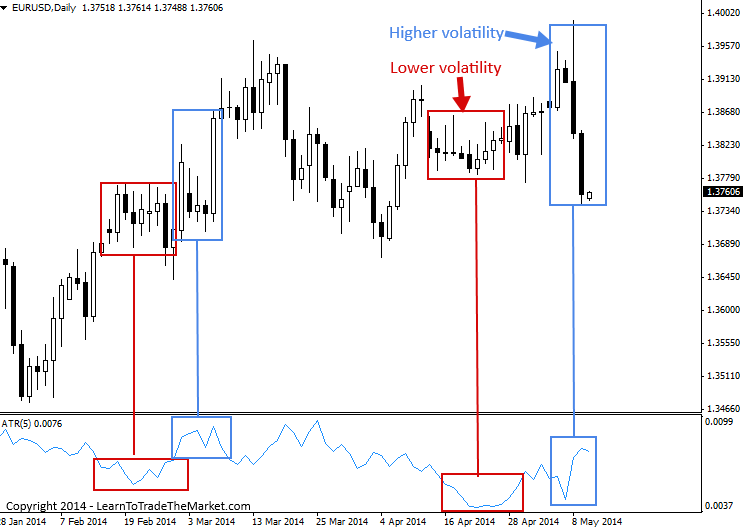
Notice how the ATR decreases in value as the volatility of the EURUSD decreases, and increases in value when the volatility increases.
I will generally use the 5 period ATR, but 5 days may be pushed out to 7 or 10 on a daily chart, however I usually stay at 5, especially for a weekly chart. 5 days of data is one week on the daily time frame, and it’s an accurate picture of current market volatility.
The ATR can help us understand current market volatility, and this can help us plan stop losses and targets. Obviously, you won’t want to place your stop loss inside the current daily ATR range, because your trade needs room to move.
The ATR can help keep your expectations in-line with reality, because it’s a reminder that a market will only move so far per day or per week, statistically speaking. For example, let’s say you’re in a trade and up 180 pips on the GBPUSD and that week the market has moved 200 points from its low to high (or vice versa), and the ATR tool shows the weekly average range is only 200…it’s a clue that the move for that week may be over and that you shouldn’t be greedy and expect more; it may be time to exit.
You can combine the ATR with key chart levels for stop losses and targets as well. If you see a key chart level that is opposing your trade, and you’re already up say 120 pips on a trade and the ATR for that week is 150, well then the approaching key level combined with the fact that you’re approaching upper limit of the recent ATR weekly range, is a good clue that you should ‘take your money and run’.
It’s important to note, the ATR is not a ‘hard and fast’ tool, but rather a guide that can help keep you grounded and help keep you in reality and out of ‘dream land’. I also want to be clear that the ATR is not an indicator for entry or exit, but it’s a tool to help you see market volatility and the average recent ranges of a market, to help you plan and manage your trades.
How to apply the ATR tool in In MetaTrader 4 Platform:
(Note: you can download mt4 charts here)
1) Click on in the ‘insert’ drop down menu at the top left.
2) Then select ‘indicators’ for the drop down menu.
3) Next select ‘Average True Range’ (should be first one)
4) Then you just need to select a color for the ATR and input the period. I like to use a 5 period ATR but will sometimes look at the 7 or 10 period ATR as well
In trading, it’s critical that you get your expectations in-line with reality, as we mentioned above. This means taking a realistic and logical approach to things like stop loss and target placement (ATR can help with this as discussed above), and not expecting a ‘homerun’ on every trade. It also means not expecting a winner every time you trade. The best traders in the world still have losing trades and many lose 50% or more of their trades. What they know is that money management, patience and discipline is how you make big money in the market, and these things are naturally at odds with our innate desire for instant gratification.
Ignoring what feels good at the moment, is a skill you’ll need to develop if you want to attain long-term trading success. This includes having patience to let trades play out, as they often don’t play out as quickly or seamlessly as we would like. You need to learn to avoid bailing on a trade at the first turn against your position, the market ebbs and flows, and moves against your position are a normal part of trading. You need to develop a plan before you enter the trade, and stick to it, don’t become overly-influenced by the normal daily fluctuations in the market. If your trade plan is still valid and makes sense, then you need to let the trade play out if you want to see your edge work for you over time.
Using the ATR, as described above, can help you control your expectations of a trade and keep them in-line with reality. However, I’ve found that what can help even more, is to simply take some time BEFORE you click that buy or sell button, and really accept the consequences of the trade you’re about to put on. You have to be OK with losing the money you are risking, so you need to really consider your position size before you enter that trade. Is the dollar amount you have at risk an amount that you’re willing to potentially lose for the opportunity to see if your trading idea plays out in your favor?
If you accept the consequences of your trade before you enter it, you will not be as affected if the trade takes longer than you expected or wanted it to. You will be more apt to sit there patiently and just let the market do its ‘thing’. Most of the time, interfering with a trade while it’s live is a bad idea. I’ve found over the years, that just sticking to my original trading plan and letting the trade play out either for a stop out or a profit, is the best route to go. I call this ‘set and forget’ trading, to learn more about this trading technique, checkout this article on set and forget trading. As always, feel free to email me here if you have any trading questions.
The post Are Expectations Destroying Your Trading Account? first appeared on Learn To Trade The Market.

