Blockchain.com Taps Polymarket to Capture Event-Trading Demand Inside Its Brokerage App
Cryptocurrency · July 15, 2026
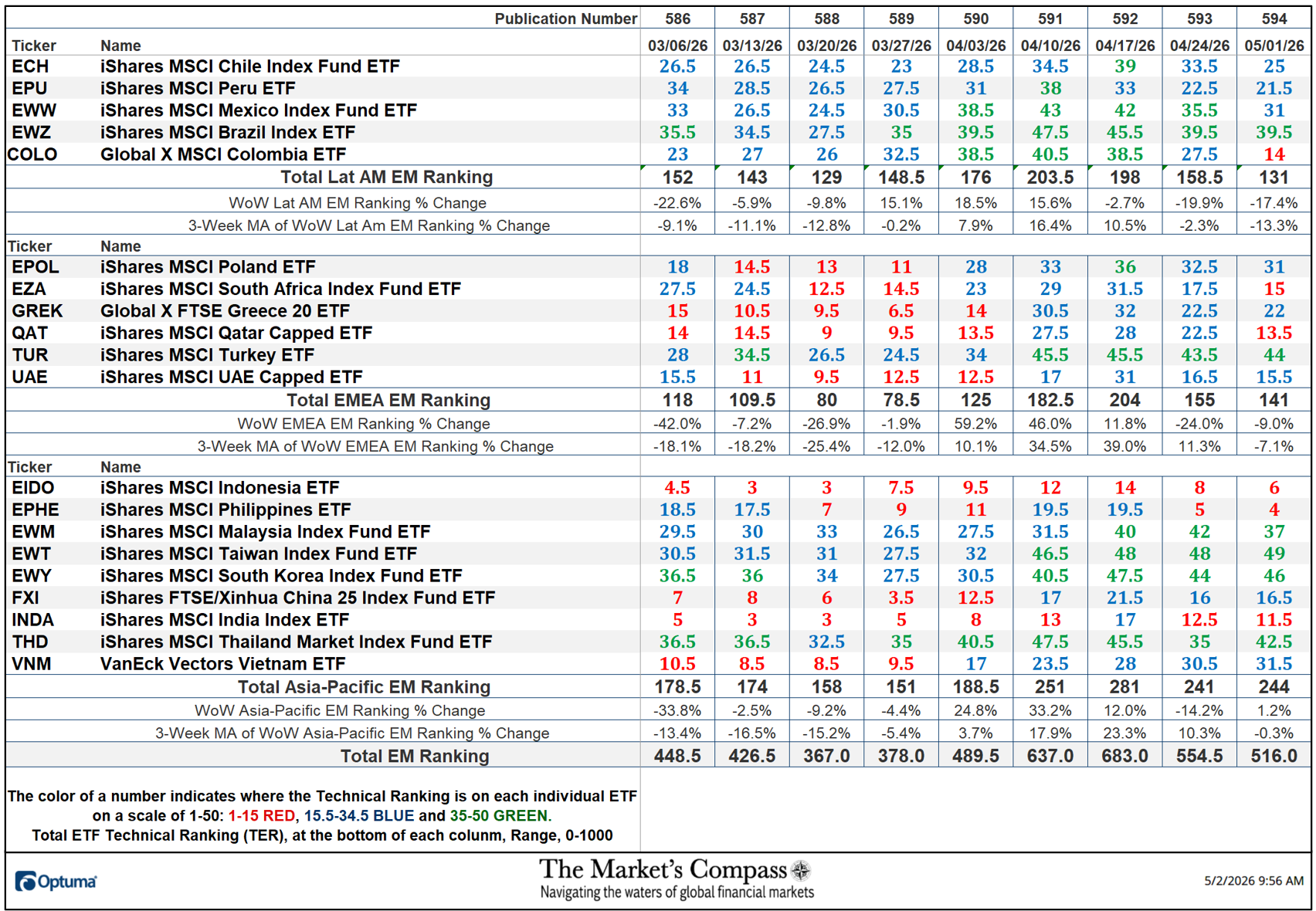
Welcome to The Market’s Compass Emerging Market’s Country ETF Study, Week #594. As always, it highlights the technical changes of the 20 EM Country ETFs that I track on a weekly basis and publish every third week. Paid subscribers will receive this week’s unabridged Emerging Market’s Country ETF Study sent to their registered e-mail. Past publications can be accessed by paid subscribers via The Market’s Compass Substack Blog. Next week I will be publishing The Market’s Compass Developed Markets Country ETF Study. Later today I will post the latest edition of The Market’s Compass Crypto Sweet Sixteen Study which I normally publish on Sunday’s, on a weekly basis that tracks the technical changes of sixteen of the larger capitalized Cryptocurrencies.
To understand the methodology used in constructing the objective EM Country ETF Individual Technical Rankings visit the mc’s technical indicators page at www.themarketscompass.com and select “em country etfs”. What follows is a Cliff Notes version* of the full explanation of the methodology I use…
*The technical ranking system is a quantitative approach that utilizes multiple technical considerations that include but are not limited to trend, momentum, measurements of accumulation/distribution and relative strength of each individual 20 EM Country ETFs that can range between 0 and 50. The Total EM Technical Ranking or “TEMTR” is the sum of the twenty individual TRs and can be viewed as an overbought / oversold indicator as well as a confirmation / non-confirmation indicator. There is also a Total Ranking for each geographic region that can be viewed as a relative measurement on a week over week basis.
This past week The Total EM Technical Ranking or “TEMTR” fell -6.94% to 516 adding to the previous week’s -18.81% loss to 554.5 from a recent high of 683 three weeks ago. The Total Asia-Pacific Ranking was the only one of the three geographic regions that was up last week (although it was up only slightly) by being up +1.2% to 244 vs. 241 the previous week. Last week the Total EMEA EM Ranking fell -9.0% to 141 from 155 two weeks ago which added to the -24.0% decline to 155 from 204 the previous week. The Total Lat AM Ranking dropped the most last week by falling -17.4% to 131 from 158.5 the previous week which was a further deterioration from the week ending April 17th when it registered a Total Ranking of 198.
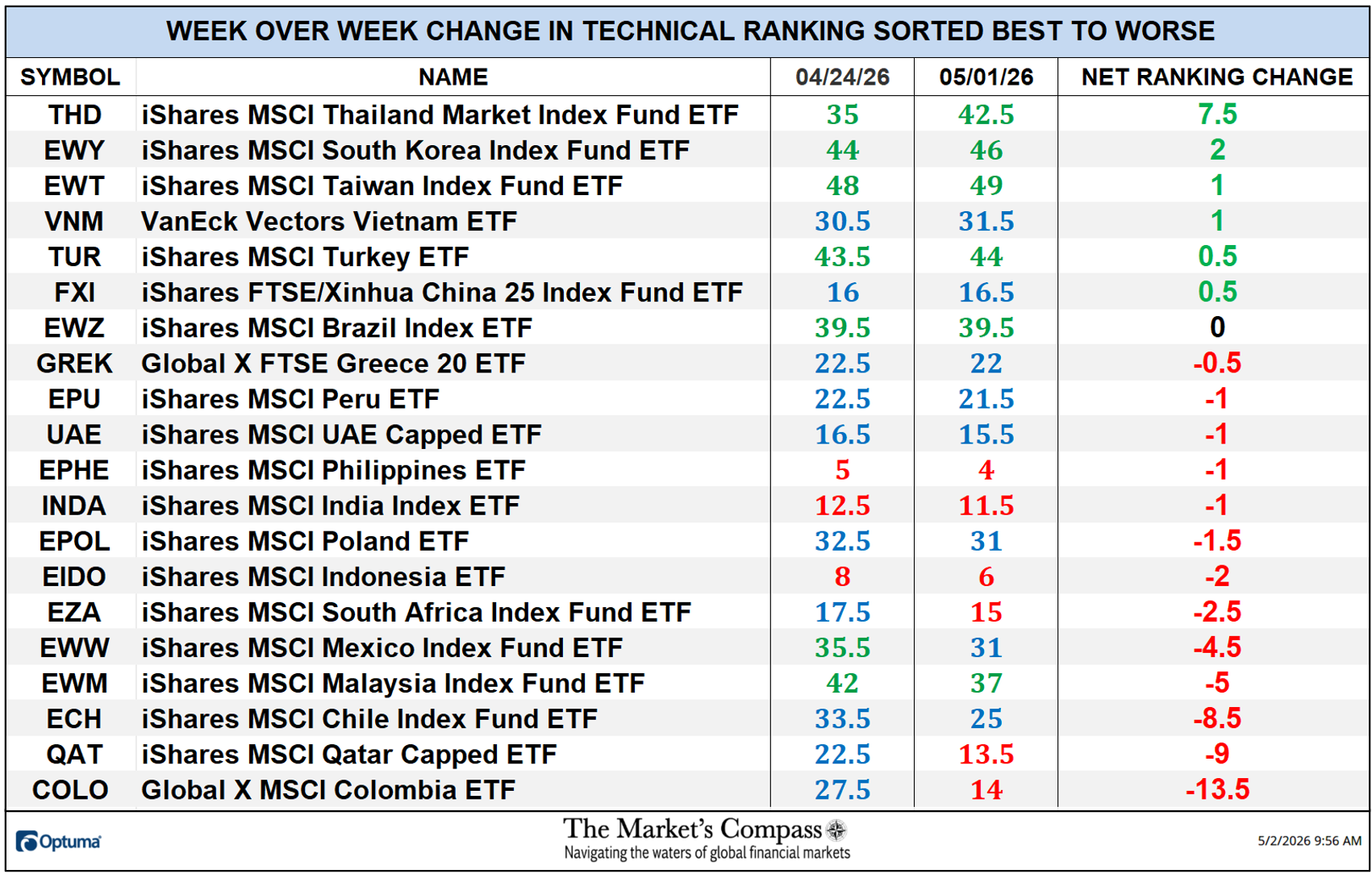
Six of the twenty EM Country ETFs I track in these pages registered gains in their Technical Rankings or TRs over the past week. Five of those that marked gains were Asia/Pacific ETF TRs. Last week six of the TRs were in the “green zone” (TRs between 34.5 and 50), eight were in the “blue zone” (TRs between 15.5 and 34), and six were in the “red zone” (TRs between 0 and 15). The previous week there were seven TRs were in the “green zone”, ten were in the “blue zone”, and three were in the “red zone”. For the first time since February 28, 2025, there was a Lat/AM ETF Technical Ranking in the “red zone”, the Global X MSCI Colombia ETF (COLO) ending the week there and fell the most TR “notches” by dropping -13.5 to 14 from 27.5. As will be seen later in today’s Study the COLO fell the most on an absolute basis last week by being down -5.95%.
*To understand the construction the of The Technical Condition Factors visit the Market’s Compass website www.themarketscompass.com and go to the mc’s technical indicators page and select “em country etfs”.
A short version of the how the Technical Condition Factors are calculated follows…
There are eight Technical Condition Factors (“TCFs”) that are a summation of the twenty ETFs TRs technical condition of each TCF question. The eight Technical Condition Factors do not ask the same number of questions. That is why it is calculated as a percentage. If a TCF individual reading is 100% that would mean that all Twenty ETFs fullfilled that particular TCF criterior.
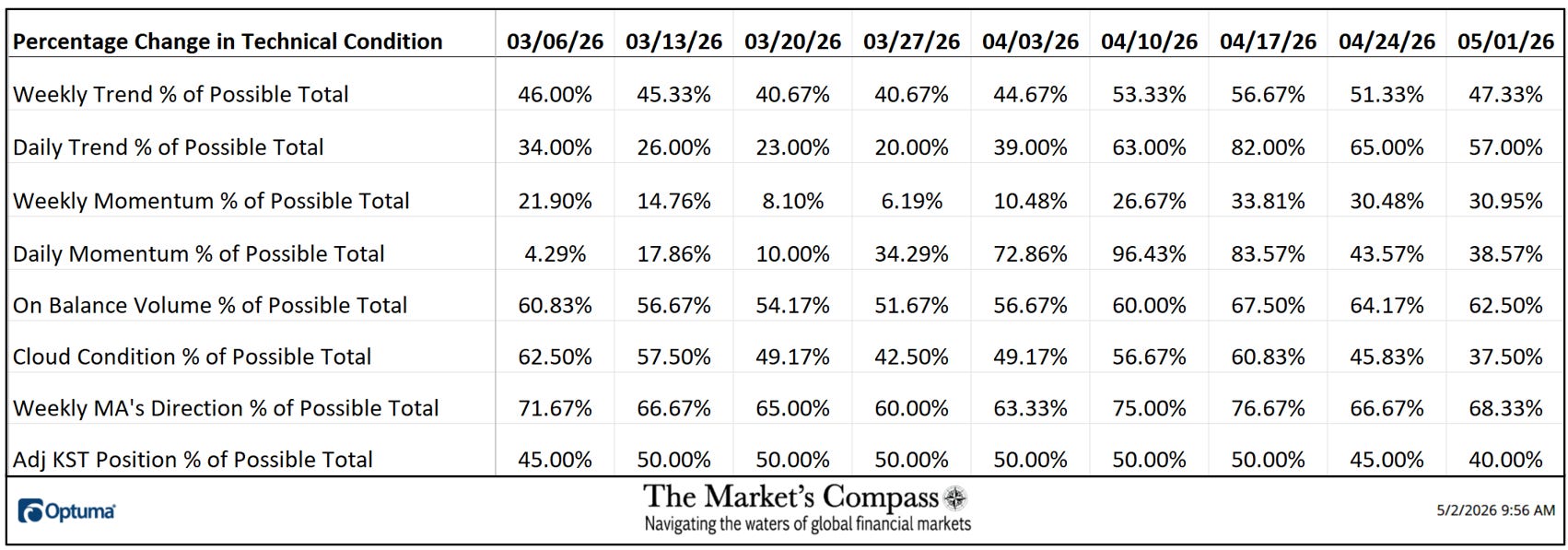
This past week a reading an overbought 38.57% was registered in the Daily Momentum Technical Condition Factor (”DMTCF”) or 154 out of a possible total of 140 positive points. That marked the third weekly drop from the overbought reading for the week ending April 10th when it reached 96.43% or 135 out of 140.
As a confirmation tool, if all eight TCFs improve on a week-over-week basis, more of the 20 ETFs are improving internally on a technical basis, confirming a broader market move higher (think of an advance/decline calculation). Conversely if all eight TCFs fall on a week-over-week basis it confirms a broader market move lower.
Last week six TCFs fell, and two rose slightly
The Relative Rotation Graph, commonly referred to as RRGs were developed in 2004-2005 by Julius de Kempenaer. These charts are a unique visualization tool for relative strength analysis. Chartists can use RRGs to analyze the relative strength trends of several securities against a common benchmark, (in this case the EEM) and against each other over any given time period (in the case below, daily) over the past three weeks. The power of RRG is its ability to plot relative performance on one graph and show true rotation. All RRGs charts use four quadrants to define the four phases of a relative trend. The Optuma RRG charts uses, From Leading (in green) to Weakening (in yellow) to Lagging (in pink) to Improving (in blue) and back to Leading (in green). True rotations can be seen as securities move from one quadrant to the other over time. This is only a brief explanation of how to interpret RRG charts. To learn more, see the post scripts and links at the end of this Blog.
Not all 20 ETFs are plotted in this RRG Chart. I have done this for clarity purposes. Those which I believe are of higher technical interest remain.
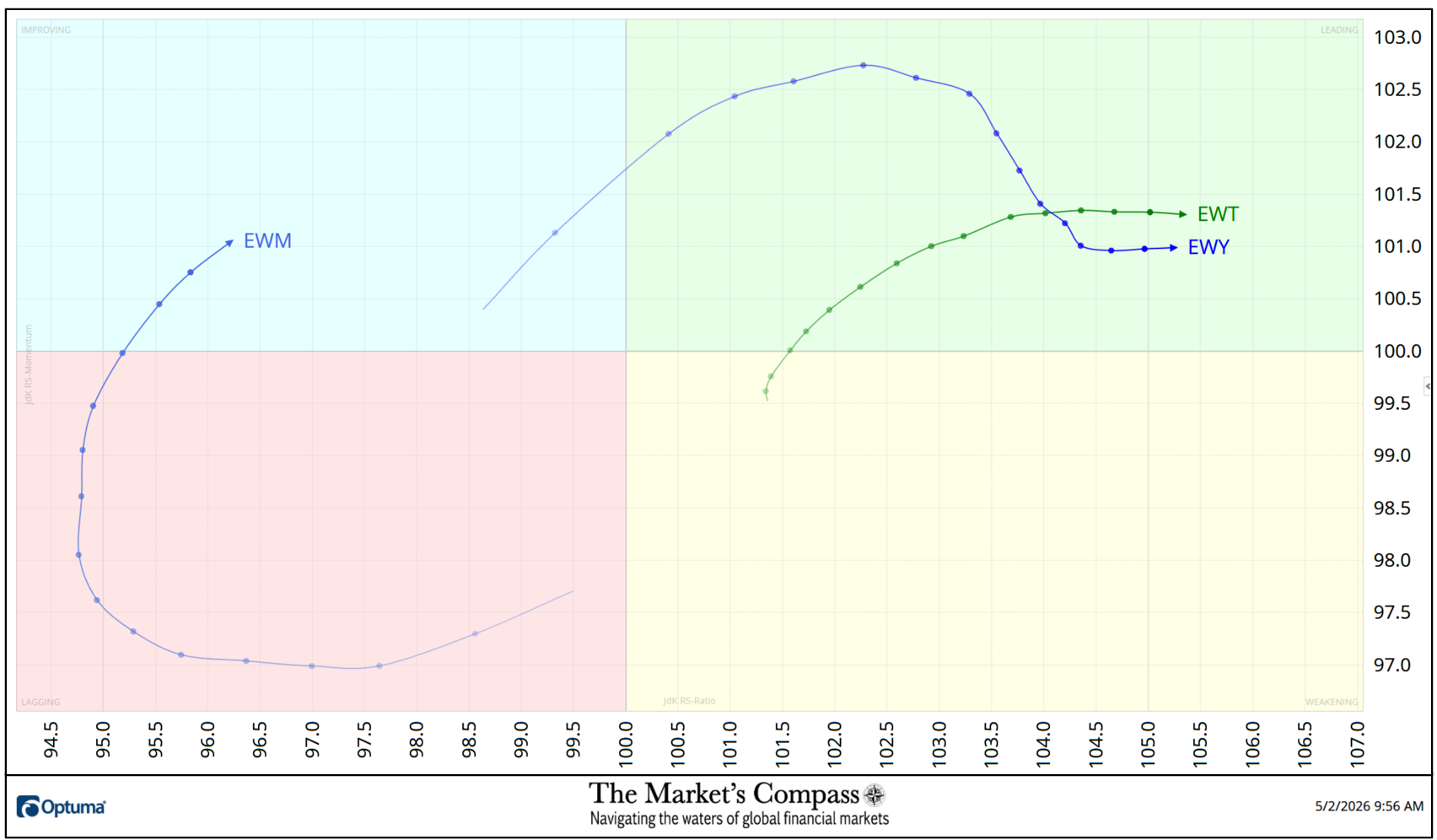
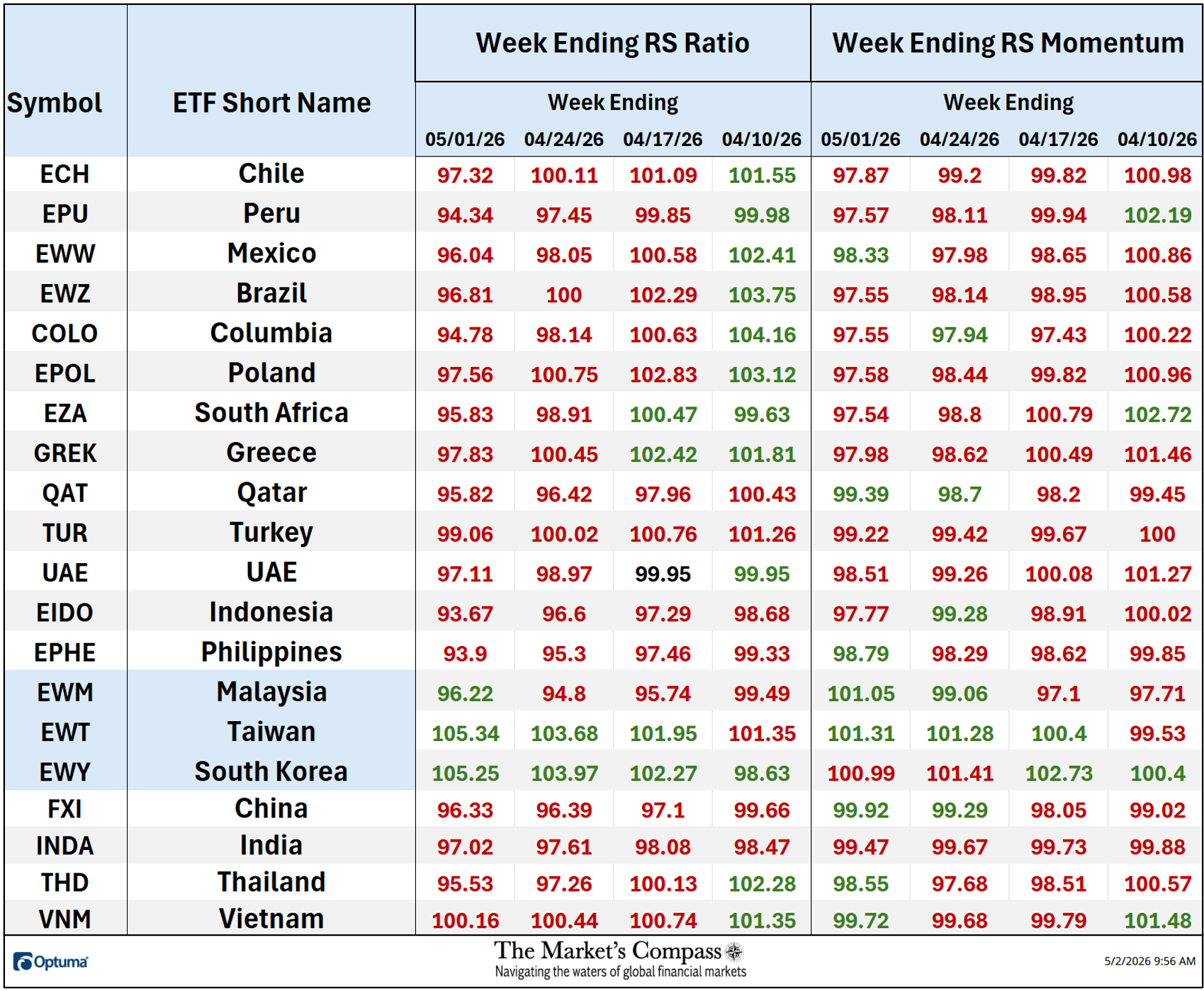
Although there has been a slowing in Relative Strength Momentum in both the iShares MSCI Taiwan ETF (EWT) and iShares MSCI South Korea Index Fund ETF (EWY) over the past week that slowing has stabilized. The EWY rolled over from a high of 102.73 three Fridays ago. Nonetheless, both have continued to gain on a Relative Strength (“RS”) basis vs. the EEM over the past three weeks, and both registered the best “RS” readings at the end of last week, at 105.34 and 105.25 respectively (see the Tabulation Table below). For the past two weeks the iShares MSCI Malaysia Index Fund ETF (EWM) has marked improving Relative Strength Momentum as it has risen out of the Lagging Quadrant into the Improving Quadrant.
The “Tabulation Table” below marks the Relative Strength and Relative Strength Momentum readings vs. the iShares MSCI Emerging Markets Index ETF or EEM. It begins with the readings at the end of last week followed by the trailing three weeks. If there has been an improvement in either the Relative Strength Ratio or the Relative Strength Momentum reading on a week-over-week basis I have highlighted it in green. If there has been a contraction in either, it is highlighted in red and an unchanged reading in either will remain black. The color-coding system serves as a heat map over the past four Friday’s readings highlighting either the continued improvement, deterioration, or stasis vs. the benchmark, the EEM. The ETFs that are displayed on the RRG chart above are highlighted in blue.
*The “ATR” serves as an overbought or oversold as well as a confirmation / non-confirmation indicator. Extremes in the ATR signals overbought and oversold conditions and should rise and drop in concert with price moves. Because it can be volatile, moving average direction and position should be the key analytical focus.
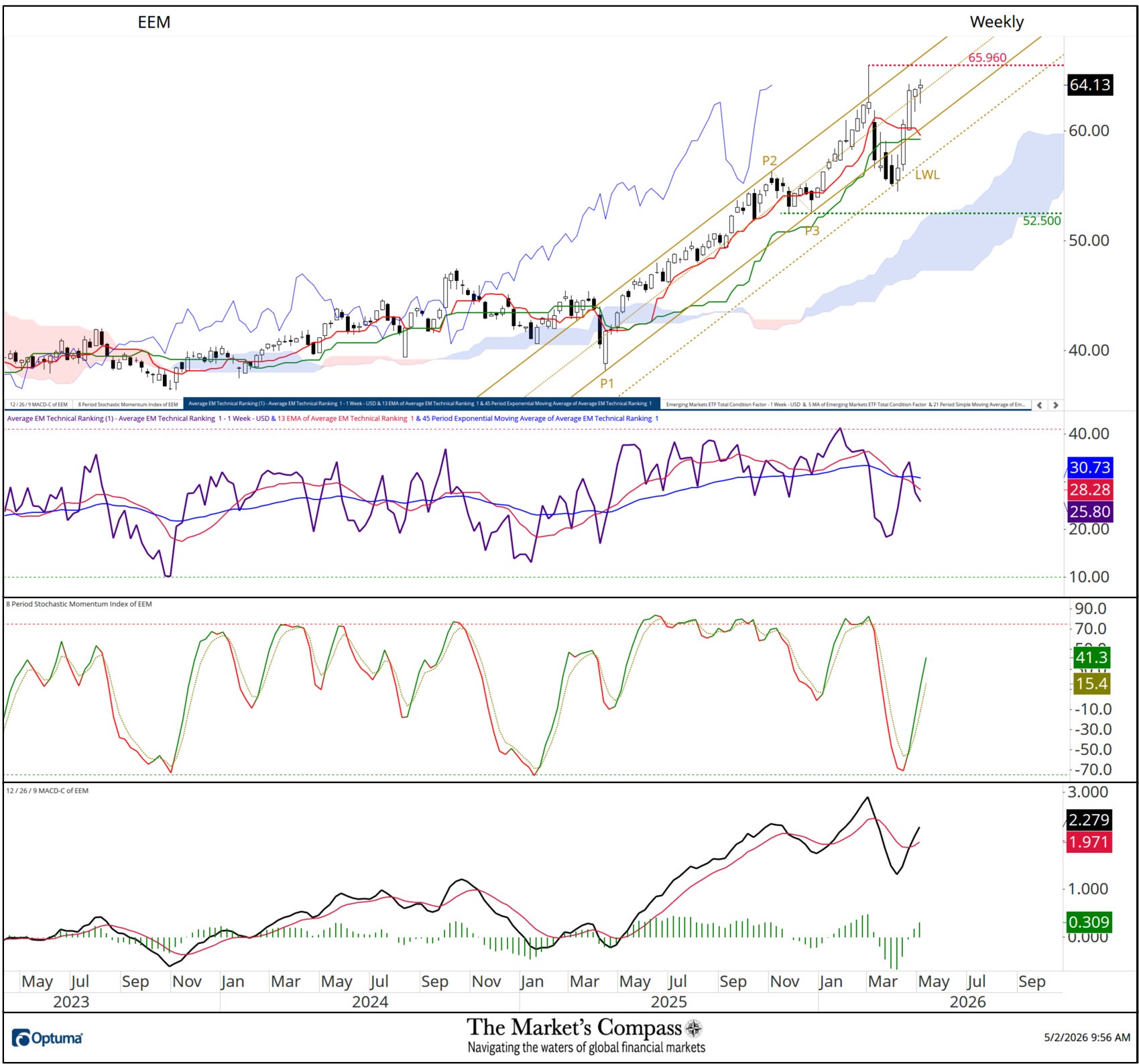
When I last published my comments on the technical condition of the iShares MSCI Emerging Markets ETF or EEM’s Weekly Chart the ETF had just risen sharply of the April 3rd lows, the following week the EEM rose back into the confines of the Schiff Modified Pitch (gold P1 through P3) and above potential price resistance at the Kijun Plot (green line) and the Tenkan Plot (red line) solidifying the technical thesis that the lows “were in”. The follow-through to the upside the following week drove the EEM above the Median Line (gold dotted line) of the multi-month Pitchfork. Over the past two weeks there has been a period of consolidation leading me write the subtitle to this week’s Study “A Time to Eat, A Time to Digest”. The Average Technical Ranking’s failure to confirm the new closing price highs (violet line in upper panel) by printing a lower high and the drop of 13-Week Exponential Moving Average or “EMA” (red line) through the longer-term 45-Week EMA (blue line) are a technical concern. The 8-Week Stochastic Momentum Index (center panel) has worked off a good portion of its oversold condition although it has not reached conversely an overbought condition yet. Longer-term MACD has turned higher and is back above its signal line. The sum of these longer-term technical features suggest that there may be “more left” to the current rally and the intra-week record highs in the EEM at 65.96 and the Upper Parallel (solid gold line) of the Pitchfork could be challenged before a correction of a larger degree unfolds.
Learn about Pitchforks and their application in the three-part Pitchfork tutorial at the Market’s Compass website, www.themarketscompass.com
More on the technical condition of the EEM in Thoughts on the Short-Term Technical Condition of the EEM but first…
*Does not include dividends if any.
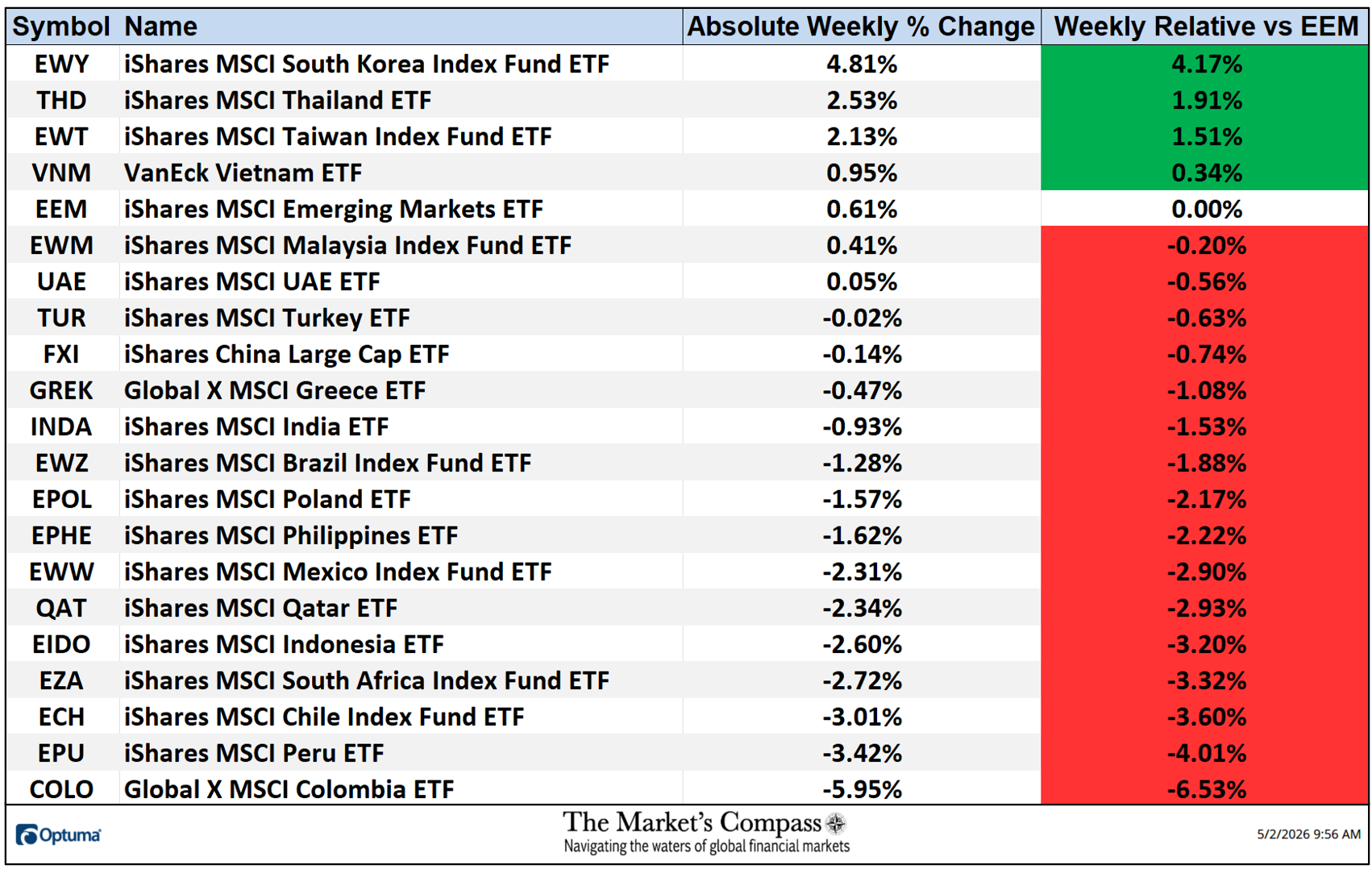
Six of the EM Country ETFs were up on an absolute basis last week. Four of the EM ETFs outperformed the +0.61% gain in the EEM on a relative basis (all four were Asia / Pacific ETF’s) and sixteen underperformed. The average five-day absolute price loss in the Emerging Markets ETFs was -0.88%, adding to the -2.36% loss the previous week.
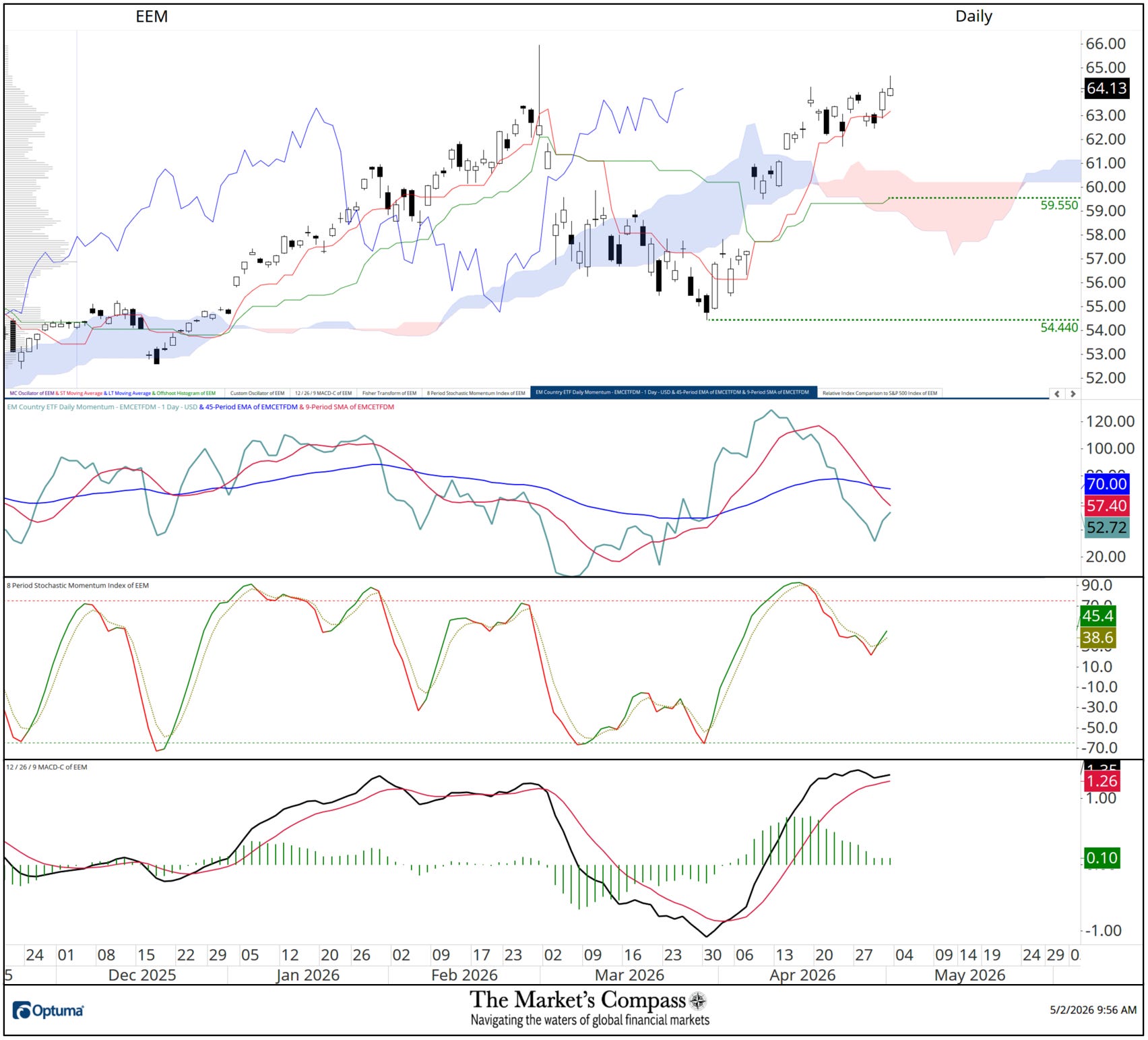
As I said in comments on the Weekly Chart, the recent price action points to a relatively strong upward price consolidation as the EEM has been able to notch a number of daily closing highs including the 64.13 close on Friday but there has been a loss of momentum and more concerning breadth as witnessed by the EM Country ETF Daily Momentum / Breadth Oscillator below the price panel. It rebounded late last week but it is more technical “sound” to monitor the action of the moving averages. Thursdays and Friday’s price action also drove a rebound in the 8-Day Stochastic Momentum Index back above its signal line and although MACD remains above its signal line it remains in overbought territory.
I have to say my money was on Emerging Market in the Derby and I will not say its an indicator but alas it did not even Show. I will post an interim report when firmer technical signals develop.
All the charts are courtesy of Optuma whose charting software enables anyone to visualize any data including my Objective Technical Rankings. The following links are an introduction and an in-depth tutorial on RRG Charts…
https://www.optuma.com/videos/introduction-to-rrg/
https://www.optuma.com/videos/optuma-webinar-2-rrgs/
To receive a 30-day trial of Optuma charting software go to…