The Download: GLP-1s and eating disorders, self-aware cities, and forever chemicals
Artificial Intelligence · October 30, 2026
Every day, your organization produces a mountain of words.
Support tickets, contracts, clinical notes, customer reviews, emails, call transcripts.
Roughly 80% of all enterprise data exists as unstructured text like this — and until recently, almost none of it could be analyzed at scale.
It just sat there.Natural Language Processing changed that.
And in 2026, with large language models now doing the heavy lifting, NLP has gone from a niche research field to the engine behind nearly every AI product you touch.
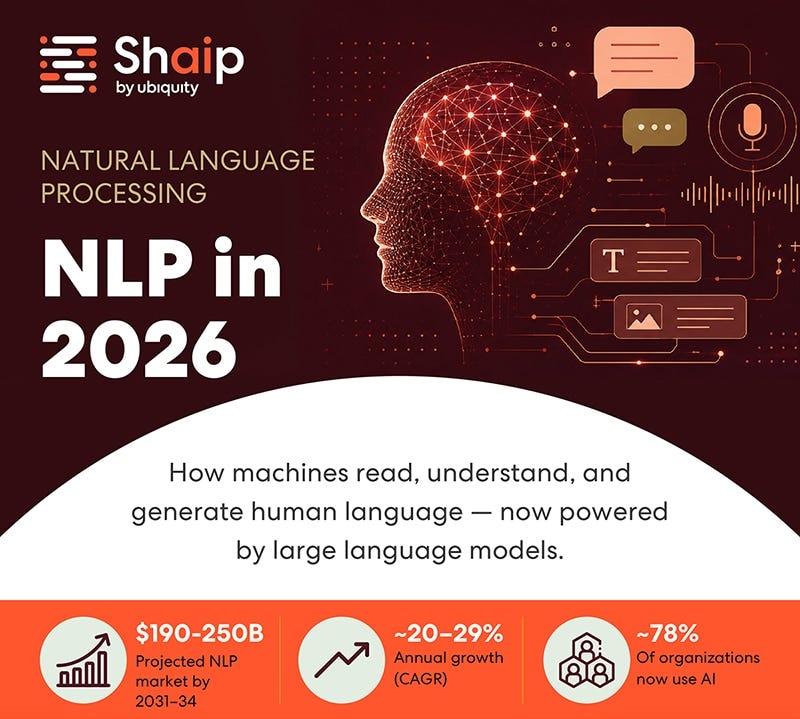
The market reflects it: analysts project NLP will grow from around $37–51B in 2025 to $190–250B by the early 2030s, and 78% of organizations already report using AI in their business.So what exactly is NLP today, how does it actually work, and where is it going?
Let’s break it down.First, Let’s Clear Up the Biggest Confusion: NLP vs. LLMAsk ten people what the difference is between NLP and an LLM, and you’ll get ten hand-wavy answers.
Here’s the clean version: NLP is the field — the entire branch of AI concerned with machines understanding, interpreting, and generating human language.
Large Language Models like GPT, Gemini, and Claude are tools within that field.