Baseten Releases joey-1, a 2B Decision Model at $0.01 per 1M Tokens
Artificial Intelligence · October 30, 2026
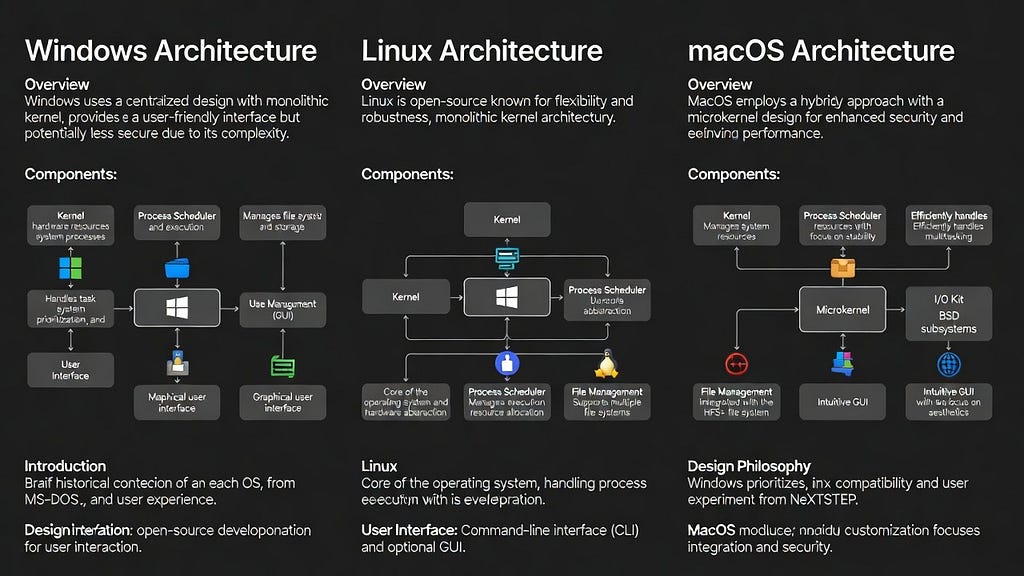
An operating system (OS) is the fundamental software that acts as an intermediary between computer hardware and user applications.
It manages hardware resources such as the CPU, memory, storage, and input/output devices, while providing essential services like process scheduling, file management, security, and user interfaces.
Without an OS, users would need to interact directly with hardware, which is impractical for most tasks.
Common examples include Microsoft Windows, which focuses on graphical user interfaces and broad hardware compatibility; Linux, known for its open-source nature and use in servers; and macOS, optimized for Apple hardware with emphasis on user experience and integration.
Operating systems can be monolithic (where all components run in a single kernel space, like traditional Linux) or microkernel-based (where services run in user space for better modularity and reliability, like in Minix).
They also handle multitasking, allowing multiple programs to run simultaneously, and provide abstractions like virtual memory to make programming easier.I will first introduce traditional operating systems and its use in current desktops, mobile devices, and servers, and will compare them with my vision for distributed operating systems, as my proposal is MEVIA OS.
The main use case is a world of AI agents (e.g.